Reading a Paper Dial Thickness Gauge Table
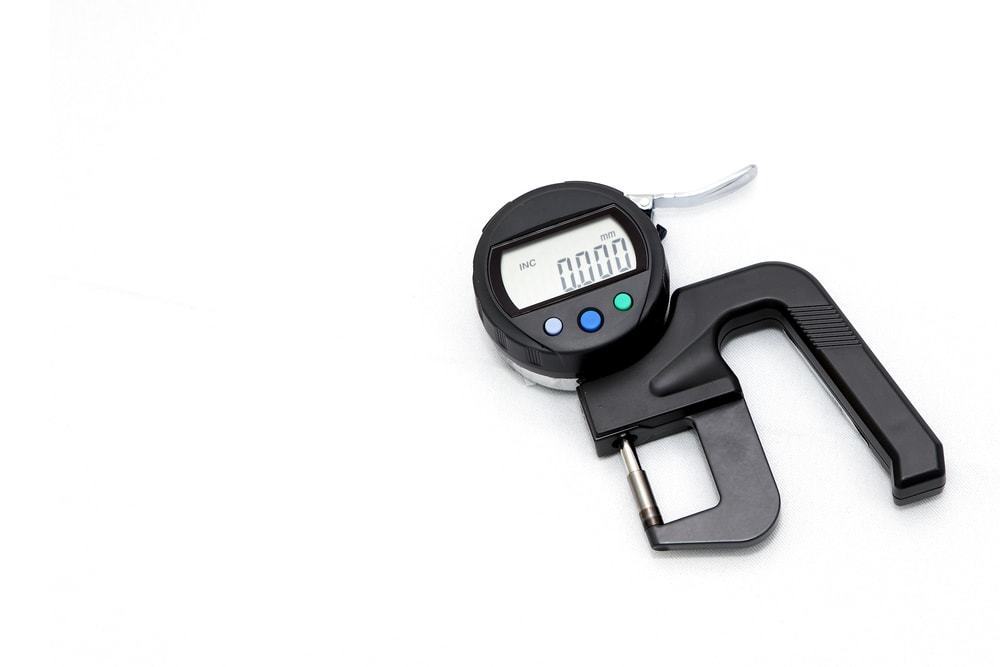
Image credit: nattanan726image/Shutterstock.com
Thickness gauges are measuring instruments that tin be used to determine the thickness or gauge of a cloth. There are actually several different types of thickness gauges, each that function in a slightly different mode depending on the intended application for the gauge. This article will talk over the common types of thickness gauges and their uses and will nowadays information about the specifications that are associated with these types of devices.
To learn more near the other varieties of gauges, see our related guide roofing the types of gauges.
Types of Thickness Gauges
The term thickness gauges has several potential meanings and may refer to 1 of these primary types:
- Fabric thickness gauges
- Coating thickness gauges
- Wire and sail metal thickness gauges
The commencement of these gauges measures cloth thickness by mechanical means – a calibrated instrument is closed effectually the sample until contact is fabricated with both sides of the material – a process akin to that of a micrometer. For purposes of this article, these gauges will exist referred to as material thickness gauges.
The 2d type of thickness guess is designed to measure the thickness of coatings applied to a surface – these are known as coating thickness gauges.
The third type of thickness approximate is a simpler mechanical device that is used for measuring wire and sheet metal thickness.
Some characterizations of thickness gauges may include tools such as feeler gauges or clearance gauges in the mix. These devices are more than associated with measuring the clearance or gap betwixt two surfaces rather than the thickness of a material or applied coating. Equally such they are not covered in this article. For more than information nearly these tools, see our related guide our All About Feeler Gauges.
Textile thickness gauges
For cases where both sides of the textile whose thickness is existence measured tin exist accessed, a cloth thickness estimate may be used. These measuring instruments are available in several varieties, which include:
- Analog (mechanical) thickness gauges
- Digital (electronic) thickness gauges
- Pocket-sized thickness gauges
Analog (mechanical) thickness gauges
The analog thickness gauges have a jaw that features steel measuring contact pins and a handle and lever. When the lever is released after the material is inserted betwixt the contact pins, the pins close over against the material surface and the measured thickness value is recorded on the analog dial past the position of a needle against a graduated scale on the punch face. The approach of having the pins close with the lever release assures accuracy and consistency in the reading because the instrument applies a uniform measuring pressure level against the fabric's surface that volition be the same from user to user.
Contact measuring pivot edges are often radiused so that the compression of the pins against the surface of the fabric will not mar or marking the surface.
Digital (electronic) thickness gauges
The electronic (digital) gauge operates functionally the aforementioned as the analog thickness gauge simply substitutes a digital display for the needle brandish. The value of the thickness reading can exist directly viewed on the digital readout without the demand to interpret the measurement from the needle position against the calibration on the dial confront.
Modest thickness gauges
Smaller versions of the analog and digital thickness gauges are known as pocket-sized thickness gauges or pocket punch thickness gauges. Instead of using the full paw to operate the gauge, the user holds the instrument between their thumb and index finger. These units are intended for performing quick checks of the thickness of materials such as newspaper, film, or other types of apartment stock. Small-scale thickness gauges are available with either analog (dial & needle) displays or electronic (digital) displays.
Sizes and specifications
The sizes and specifications for material thickness gauges are outlined below. Annotation that there will be some variation in the specifications, depending on the blazon of dial thickness estimate being considered. The parameters shown below are intended to provide an overview of what to await for and consider when seeking a dial thickness approximate. The size of a thickness gauge may refer to the thickness gauge range, but other parameters such as the approximate accomplish is a relative indicator of size as well.
- Brandish blazon – for analog gauges, a mechanical dial indicator is used. For digital (electronic) gauges, the display types are commonly LCD or LED.
- Contact (anvil & spindle) type – typical contact pins are flat steel whose surfaces are parallel to each other, with a radiused edge. Some are rounded, while others are in the shape of a blade. Other materials include ceramic faces for longer habiliment.
- Contact diameter – measures the bore of the contact pin.
- Thickness gauge range – indicates the range of values for which the gauge tin provide a reading of material thickness, for instance, 0 to 0.0500 inches.
- Approximate achieve – (also referred to as throat or throat depth), this value is an indication of the distance that the estimate may be inserted from the edge of the material before the cloth's border strikes against the back of the frame. Throat depths tin can exist fractions of an inch or can be much larger, such as 12" or xvi". Every bit the thickness judge throat increases to large values, the sturdiness of the frame must increase to avert a distortion in the frame from its weight causing problems with the accuracy of the thickness measurements.
- Throat clearance – There are as well models that are more than like calipers, chosen caliper type thickness gauges. For these, the throat clearance is the maximum separation when the jaws of the unit are opened
- Gauge resolution – an indication of the granularity or fineness for which the thickness gauge can provide a measurement. A gauge with a range of 0 to 0.0500 inches might have a resolution of 0.0001, meaning that it tin can resolve values downward to a ten-thousandth of an inch.
- Gauge accuracy – is a measure of the ability of the approximate to reflect the actual thickness of the material, expressed every bit a +/- value or a pct of the total-calibration reading (e.k. +/- 0.0002).
- Measuring force – the amount of force (for metric units, in Newtons) which is exerted on the material when the contacts close on the fabric for the thickness measurement. For softer materials such as plastics or fabrics, there may be the need to be concerned with the magnitude of the measuring force.
- Measurement system – thickness values may display every bit metric or imperial (English language) units.
- Bombardment type – for digital gauges, indicates the specific battery that is installed in the unit of measurement.
Coating thickness gauges
In some cases, it is of import to measure the thickness of a material that has been practical to another surface, such as a blanket or a paint applied to a piping. In instances such equally these, material thickness gauges will not suffice because merely one side of the blanket or paint is available, so a textile thickness gauge as described before cannot function to accept a measurement. Coating thickness gauges (sometimes referred to every bit pigment meters) provide a measurement of coating thickness to assure that the coating complies with required standards.
At that place are generally two types of coating thickness gauges. The simpler of these is a destructive measurement procedure in which the judge pierces the dry coating down to the substrate and thus directly establishes the coating thickness. The obvious problem with this method is that it requires damaging the integrity of the coating in order to have the reading. In that location are also wet coating gauges that measure the thickness of a coating earlier it has cured
The second blazon of coating thickness gauge uses a non-destructive process to decide coating thickness. In that location are several technologies that are used for these types of thickness gauges, a mutual 1 being ultrasonic waves.
Ultrasonic thickness gauges
An ultrasonic thickness approximate contains an ultrasonic transducer that emits a pulse of sound moving ridge energy into the coating. When sound waves striking a material boundary, in this case, the boundary between the bottom of the coating and the substrate, in that location is a reflection that occurs, sending a render pulse back to the transducer. By measuring the fourth dimension that information technology takes for the return pulse to be detected, the coating thickness judge can establish the thickness of the coating or paint.
This methodology works on a whole variety of materials, including metals, plastics, composites, fiberglass, and ceramics, to name a few. The advantages of this method of gaging include:
- Information technology only requires access to i side of the material, making it ideal for pipes, tubing, hollow castings, and other cases with limited access
- It is not-subversive
- Information technology offers a wide measurement range
- It provides rapid results
- It is easy to apply
Dry out film thickness gauges
When coatings whose thickness is being measured are non-magnetic but practical to a magnetic substrate such as atomic number 26 or steel, there are several types of magnetic thickness gauges that can exist used to decide the thickness of the coating application. A and so-called type i magnetic pull-off gauge uses an estimate of the force needed to pull a magnet away from the coated substrate to gauge blanket thickness. These gauges contain a permanent magnet and a calibrated leap with a graduated scale. The thicker the coating, the less the force needed to remove the magnet – the thinner the coating, the greater the strength needed. Hence, the pull abroad force can be used to estimate coating thickness.
A blazon 2 magnetic judge works using past measuring the changes in the magnetic field generated from a probe equally that device is placed on the coating (this is again used in the case of a non-magnetic coating that is over a magnetic substrate). The alter in the magnetic field strength will vary as a function of the distance between the magnetic substrate and the probe on the coating surface. Many of these devices use a constant pressure probe then that the operator's pressure against the coating is not a gene in the estimate of the coating thickness.
There are also roll-dorsum magnetic pull-off thickness gauges that part in a similar way to the magnetic pull-off gauges described above. These devices feature a permanent magnet fastened to one stop of a balance arm that can pivot as the user rotates a dial with their finger. A calibrated spring is used to display the force needed to pull the magnet away from the surface, which again is a proxy for the blanket thickness between the magnet and the underlying substrate.
Other coating thickness gauges and instruments
Three additional instruments that can be used to measure coating thickness are magnetic induction instruments, electromagnetic instruments, and eddy current thickness gauges. The first two of these three part past measuring the alter in the magnetic flux density at the surface of a magnetic probe as it is brought near the surface of a coated steel surface. The measured flux density values can be used to estimate the thickness of the coating applied to the surface.
The eddy electric current thickness estimate works on non-conductive coatings that are applied to non-ferrous metallic substrates. These units generate a high-frequency alternating current which generates an alternate magnetic field. Every bit the field approaches the surface, the alternate magnetic field creates eddy currents on the surface which in turn event in the creation of an opposing magnetic field. The opposing field can be detected by the eddy current thickness gauge and used to guess the blanket thickness.
Calibration
Material thickness gauges and coating thickness gauges crave calibration against standard material test pieces in order to assure that the device readings provide and maintain accurate values. For instance, with ultrasonic coating thickness gauges, the speed of the sound energy will be dependent on the material in which information technology propagates. Table ane below shows the speed of sound transmission in meters per second for unlike material types. This characteristic must be stored and used to establish the pulse transit time (and therefore the material thickness).
Tabular array one – Magnitude of audio velocity for different materials
| Material | Velocity (yard/s) |
| Aluminum | 3040 – 6420 |
| Brick | 3600 – 4200 |
| Concrete | 3200 – 3700 |
| Copper | 3560 – 3900 |
| Glass | 3950 – 5000 |
| Fe | 3850 – 5130 |
| Lead | 1160 – 1320 |
| Steel | 4880 – 5050 |
| Wood | 3300 – 5000 |
Table data: Cygnus Instruments Inc.
Similarly, material thickness gauges are frequently sold with calibration blocks that tin be used to calibrate the judge by placing material of known thickness betwixt the contact pins or caliper arms to validate readings.
Wire and sheet metal thickness gauges
Wire and sheet metal thickness gauges are metal templates into which precision holes and slots have been cut. These devices can enable a user to easily assess the estimate number of sail metal for steel or iron and wire guess size for steel, aluminum, brass, and copper wire. Gauges encompass the U.South Standard Iron and Steel Estimate, the American Wire Gauge (AWG), and the U.S. Steel Wire Gauge. The gauges allow the user to directly read the corresponding guess numbers from these templates, and to access the decimal equivalent sizes every bit well. While called by the term thickness gauges, they differ in the sense from the other types of gauges mentioned in this article in that they more for validating a material against a standard set of sizes, as opposed to measuring a value whose magnitude is unknown.
For boosted information on standard sheet metal sizes, see our related guide on sheet metal approximate.
Summary
This article presented a summary of thickness gauges including what they are, the types, sizes & specifications, and their uses. For data on other topics, consult our additional guides or visit the Thomas Supplier Discovery Platform where you tin locate potential sources of supply for over 70,000 unlike production and service categories, including over 100 suppliers of thickness measuring and testing instruments also every bit suppliers of ultrasonic thickness gauges, thread plug & ring gauges, feeler gauges, digital force per unit area gauges, bore estimate, depth gauges, profile gauges, band gauges, plug & ring gauges, thread gauges, and get/no-get gauges.
Sources:
- https://www.pce-instruments.com/us/measuring-instruments/test-meters/thickness-gauge-kat
- https://www.measurementshop.co.u.k./blog/guides/all-you-need-to-know-about-thickness-gauges
- https://world wide web.reliabilitydirectstore.com/Thickness-Gauges-southward/440.htm
- https://www.elcometer.com/en/coating-thickness-gauge.html
- https://www.greatgages.com/collections/deep-throat-thickness-gages?folio=2
- http://www.longislandindicator.com/p12.html
- https://www.olympus-ims.com/en/applications-and-solutions/introductory-ultrasonics/introduction-thickness-gaging/
- https://www.cygnus-instruments.com/
- https://www.corrosionpedia.com/7-methods-of-coating-thickness-measurement/2/6545
- https://www.qualitymag.com/articles/87956-quality-101--understand-coating-thickness-measurement-exam-methods
- https://world wide web.starrett.com/category/precision-measuring-tools/special-function-dial-gages/110507#currentPage=1&displayMode=grid&itemsPerPage=12&sortBy=wp/asc
- http://www.davis.com
- https://www.grainger.com/category/machining/precision-measuring-tools/thickness-gages
- https://world wide web.mcmaster.com/thickness-gauges
Other Gauges Articles
- Mechanical Gauges: An In-Depth Await at the Different Types of Gauges
- Magnetic Liquid Level Gages
- All Near Feeler Gauges - Definition, Sizes and Uses
- All Virtually Digital Pressure Gauges - Definition, Sizes and Uses
- All About Bore Gauges - Definition, Sizes and Uses
- All Virtually Depth Gauges - Definition, Sizes, and Uses
- All About Profile Gauges - Definition, Sizes and Uses
- All About Ring Gauges - Definition, Sizes and Uses
- All About Snap Gauges - Definition, Sizes and Uses
- All About Plug Gauges - Definition, Sizes and Uses
- All Virtually Force Gauges - Definition, Sizes and Uses
- All About Height Gauges - Definition, Sizes, and Uses
- All About Level Gauges - Definition, Sizes, and Uses
More from Instruments & Controls
Source: https://www.thomasnet.com/articles/instruments-controls/all-about-thickness-gauges/
0 Response to "Reading a Paper Dial Thickness Gauge Table"
Post a Comment